

Ruffed grouse or partridge?
The ruffed grouse, Bonasa umbellus, is a non-migratory, medium-sized bird found in woodland across much of Canada, including Ontario. In Northern Ontario, hunters often call it partridge. That familiar camp name means ruffed grouse here; gray or Hungarian partridge is a separate species. It spends much of its time on the ground. When surprised, it can suddenly burst into flight with noisy wingbeats, leaving a familiar sound long after the bird has gone from view.
That is part of what makes a walk for ruffed grouse so memorable. A quiet stretch of young woods can end in a sudden flush. Give yourself time to learn the bird, read the cover and enjoy the route, whether you are walking with a dog, a partner or on your own. A legal place to walk and a clear return plan belong at the start of every outing.
Ontario range map
From the original field notes
Ruffed grouse · Ontario
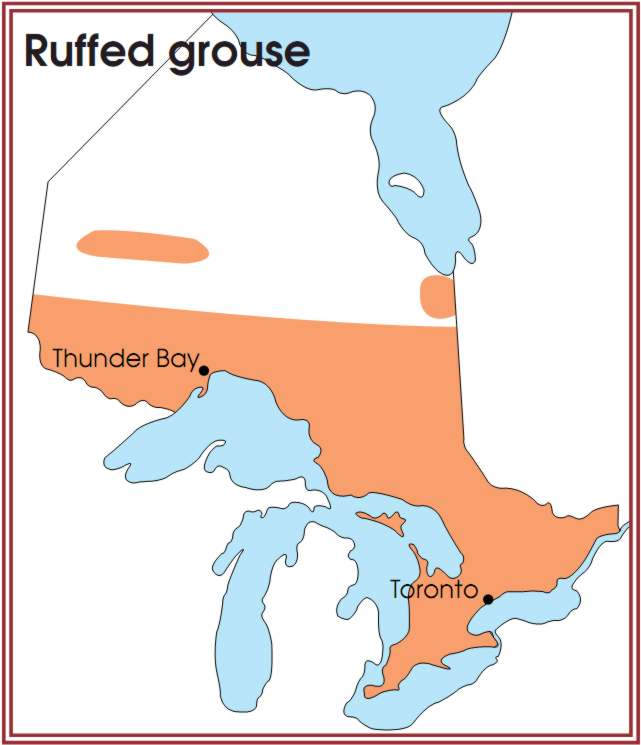
- Orange: areas shaded on the original map
- Blue: water
A reference map from our older website. It is not a current survey or a hunting-access map.
Open the full map ↗ · Cornell range map ↗ · Recent sightings ↗
Grey feathers, brown feathers and the neck ruffs
Ruffed grouse have grey and reddish-brown colour morphs, with birds between those shades too. The grey bird has a grey-brown back, neck and head, while its underside is lighter. A reddish bird has warmer brown plumage. Both have a broad tail with a dark band near its tip. They are colour differences within one species, not separate kinds of grouse.
Ruffs are located on the neck of both males and females. There is also a small crest on the head. It can be difficult to tell the sexes apart because they have similar size and markings. For a hunting identification check, first learn the whole shape, neck and tail rather than depending on colour or trying to name the sex. Compare the real photographs on our identification page before the trip.
Food, young woods and changes in cover
Ruffed grouse use woodland with aspen and other broad-leaved trees. They feed on a mixture of vegetation, berries and small invertebrates, foraging in trees or on the ground. Winter buds and catkins help carry adults through the cold months; insects and other small animals are important for growing chicks. Their wide food menu lets them use several woodland settings through the year.
On your own route, look for the tree age, growth beneath the trees and nearby shelter. Young woods beside older cover give you more to study than a map's large block of green. Notice wet margins, brush and openings, then write down the changes. Work out ownership and restrictions before treating any logging road as a place to hunt.
Give the walk a sensible shape
Choose a short route with a known return before setting off. A loop can be handy when the terrain allows it, but an out-and-back walk is often easier to judge in unfamiliar country. Mark the vehicle location on your navigation device and keep a paper map in your pack. Tell someone where you will be and when you expect to return.
Walk at a pace that leaves time to notice the edges beside you. You are looking at the woods, listening to your companions and keeping your footing, all at once. If the brush becomes too thick for a clear view, change your route. There is no need to turn a pleasant grouse walk into a struggle through every wet hollow.
Early cover and late cover
An early autumn route and a later autumn route can feel like two different places. Leaves can hide the ground and shorten your view. Later, bare branches show more of the woods while wet leaves, frost and snow change the footing. Plan your clothing for the weather you have, not the calendar picture you had in mind at home.
Keep a few route options rather than one favourite trail. A sheltered section may suit a wet day, while a longer walk may make sense when everyone is comfortable and the light is good. Decide the return time before you begin. Finishing with dry layers and enough daylight to tidy up at camp is a good way to end the day.
With a dog, or with a partner
A dog can make the day rewarding, but the route still needs to fit the team. Agree on the dog's working distance, the hunters' positions and what everyone will do when a bird rises. If you are walking without a dog, keep the same care with spacing and communication. Losing sight of a partner is a reason to stop and speak up, not a reason to keep pushing into the next patch.
Short walks make it easier to pause, check the dog and review the route. Carry water for both yourself and the dog. Choose a base that accepts dogs before booking, and ask about the camp's current rules rather than assuming a hunting lodge permits them.
Keep a small field notebook
Record the place, weather, general cover and length of the walk. If you see a bird, note the type of cover rather than only the exact spot. Over several days, your notes can help you pick the next route with more purpose. A quiet walk can still teach you plenty about access, footing and the kind of woods you want to return to.
Keep those notes honest. One sighting does not prove a place holds large numbers of birds. One empty afternoon does not prove it is poor country. The point is to build a record of your own trip, not to turn each outing into a sweeping claim.
Finish with the next trip in mind
Before heading out again, review the current species rules for the actual wildlife management unit, check your documents and look at the weather. Use the habitat guide to plan your cover, the gear page to sort your day pack and the regional pages to choose your camp base. A ruffed grouse trip is built from these small decisions. The woods supply the rest: the smell of leaves, a sudden flush and the long walk back with something to talk about.
From the grouse notebook
A few facts worth knowing.
A name from the neck feathers
The ruffed grouse is named for the neck feathers it can spread during a display.
One species, different colours
Ruffed grouse can show grey or reddish-brown plumage. Colour alone is not enough for identification.
At home through winter
Ruffed grouse do not make a long seasonal migration. Young birds spread out to find home areas.
Read the sources: Cornell Lab: ruffed grouse guide ↗ · Connecticut wildlife agency: ruffed grouse biology ↗
Useful sources & official links
- Cornell Lab: ruffed grouse identification ↗
- Cornell Lab: ruffed grouse life history ↗
- Hinterland Who's Who: ruffed grouse ↗
- Ontario: small-game rules ↗
- Northern Wilds: ruffed grouse and the northern partridge name ↗
Source check: October 11, 2026. Confirm current trip and rule details before travelling.





