

A separate bird and a separate Ontario trip
The sharp-tailed grouse, Tympanuchus phasianellus, belongs to a North American group that also includes prairie-chickens. Its more open habitat gives an Ontario trip a different setting from the thick young woods often linked with ruffed grouse. Begin with the bird's cover, then check that the actual destination has the species, an open season and lawful access. One field or a large open patch is not enough to settle those questions.
Say which species you mean when speaking with a camp. A general answer about grouse hunting may describe ruffed grouse outings. Ask whether sharp-tailed grouse are part of the operator's current trip offering, what land guests use and how permission is arranged. The right base is the one that fits your actual bird and daily plan.
Ontario range map from the original website
The shaded areas give a broad reference for reading the older site's sharp-tailed grouse notes. Compare them with Cornell's range and sightings maps, then check current species rules, land permission and your actual destination.
From the original field notes
Sharp-tailed grouse · Ontario
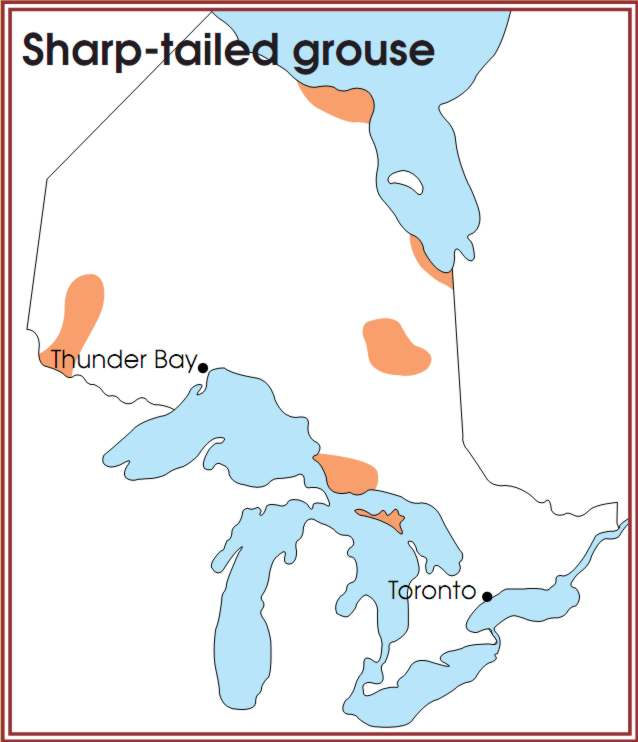
- Orange: areas shaded on the original map
- Blue: water
A reference map from our older website. It is not a current survey or a hunting-access map.
Open the full map ↗ · Cornell range map ↗ · Recent sightings ↗
A pointed tail and a patterned breast
The bird gets its name from its pointed tail, with central feathers longer than the outer feathers. Its plumage has mottled brown colours against paler areas, and the lower belly is white. Dark V-shaped markings on the breast are useful clues. Adult males can show a violet neck patch during display and a yellow comb over the eye. These details belong in identification study before the hunt.
Compare photographs of standing birds with views of birds walking or flying. A clear picture gives you time to study the whole shape, while a field view may hide the tail or chest. Use several marks together. Do not let a long journey or a hoped-for sighting turn an unclear glimpse into a firm identification. Leave an uncertain bird alone and carry on with the walk.
Food, brush and the spring dancing ground
Feeding patterns change with the seasons. In summer, sharp-tailed grouse forage on the ground for seeds, berries, leaves and insects. During winter, they also feed in trees on buds and other plant food. Open ground, grass and shrubs have different jobs through the year, including feeding, nesting and shelter. Dense forest by itself does not describe the whole setting this bird needs.
Sharp-tailed grouse are a lekking species. A lek is a place where males gather to display. Their spring courtship includes rapid foot stamping, raised tails and calls. Females visit the display ground, then nest and raise the young without help from the males. A spring display is part of the bird's biology, not directions to an autumn hunting location. On your checked route, record the cover and birds you actually saw rather than repeating a rumour about a whole region.
Check the species table, not just the date
Sharp-tailed grouse have their own Ontario season and limit table. A number you remember from a ruffed grouse trip may not apply. Use the current provincial summary, find the correct wildlife management unit and check all restrictions relevant to your method and location. Keep the rules with your trip papers so that everyone in the group can review them.
If a proposed route runs near a unit boundary, plan around that boundary before leaving camp. A broad tourism region is not a unit. Our rules page provides the official links, while the regional pages help with base-camp planning. Use both kinds of reading for their proper jobs.
Plan for an open-country walk
The route may offer longer views than a woodland trail, but it can still hide drainage cuts, soft ground and changes in footing. Choose a walk that fits the least experienced person in the group. Set a return time, mark your starting place and take enough water for the actual distance. A clear horizon does not remove the need for navigation.
Think about wind and exposure when choosing clothing. An extra layer that stayed in the pack during a sheltered forest walk may be welcome in open ground. Keep rain protection handy rather than buried beneath everything else. The aim is to stay comfortable enough to pay attention through the whole walk.
Make the team plan clear
Agree on positions, direction of travel and signals before you begin. On open ground, people may be tempted to spread farther apart. Keep communication easy and pause whenever the route or visibility changes. If a dog is working, everyone should know where it is and who is handling it. A bird rising is no reason to lose track of the team.
Walk only ground you have checked and may legally enter. A tempting patch across a fence is still someone else's land. Ask permission ahead of time, and keep the agreed access details with the rest of your route notes. Respect any limits the landowner sets.
Record the cover, not a rumour
Your notebook should describe the kind of ground, weather, time spent and birds you actually identified. This keeps later trip planning grounded in your own experience. It also helps separate a worthwhile habitat search from a road that simply passed through attractive country. Write down the access arrangement too, because permission or road conditions may need checking again next year.
Avoid turning one sighting into a named hotspot for everyone. Bird numbers change, property agreements change and an online post can bring traffic to a place that was never meant for public use. A modest record is more useful than a sweeping report.
Keep the trip worth taking
Plan enough time to learn the country, but leave room for another activity if the hunting plan does not work out. Ask your host about meals, drying space and nearby services. Carry the packing list, read the other bird guides and keep species checks at the centre of the day. A sharp-tailed grouse trip is a chance to see a different side of Ontario's uplands. Let that setting be part of the reason you go.
From the grouse notebook
A few facts worth knowing.
A spring dance floor
Sharp-tailed grouse display together on open grounds called leks, where males stamp their feet and raise their tails.
Snowshoes for sharp-tails too
Sharp-tailed grouse also grow small toe projections that help spread their weight on snow.
Snow tunnels at night
Sharp-tailed grouse sometimes make tunnels in snow for a sheltered night roost.
Read the sources: Cornell Lab: sharp-tailed grouse guide ↗
Useful sources & official links
- Cornell Lab: sharp-tailed grouse guide ↗
- Cornell Lab: sharp-tailed grouse life history ↗
- Ontario: small-game rules ↗
Source check: October 11, 2026. Confirm current trip and rule details before travelling.





